
00 / The bigger picture
Care doesn't stop
at the car door.
Families were already using Grab together. Booking a ride for a parent. Paying for a sibling. Waiting for a teenager's “I'm home.” But the product still largely understood a ride as one person, one phone, one account.
From 2023 to 2025, I owned design across three connected releases: Family Account MVP, booking on behalf of family, and Teens. The work was to make the people around a ride part of the experience, while keeping the person taking it in control.
- My role
- Design owner
- Period
- 2023–2025
- Surfaces
- Passenger & driver
- Team
- Grab · Integrity
The behavior came first.
More than half of surveyed Grab users in Singapore, the Philippines and Indonesia already booked rides for family.
Grab's published research ↗01 / Family Account MVP · 2023
A family, connected.
Not one shared login.
The first release let members book their own rides from their own accounts. A family admin could pay through a shared payment method, follow the ride and receive updates. A group chat connected the admin, the rider and the driver.
This changed the design problem. It wasn't just a booking flow anymore. It was a relationship: who can see the journey, who pays for it, and what each person understands before they agree.
Make the first invitation easy.
Leave room for the rest.
We started with a multiple-contact invitation flow. After alignment with design leadership, we narrowed the MVP to getting the first member invited and the family created. When the CX team raised concerns, Razil and I worked through the fuller multi-invite option too. Comparing both helped the team align on the simpler release.
The important detail was underneath the screens: both approaches used compatible Duxton components. A list item could become a checkbox row later. A smaller first release would not force engineering to rebuild the foundation.
Multiple contacts
More setup at once.
A larger first task.
One member first
Complete the first connection.
Keep components upgradeable.
Share an invite link
No contact-list permission.
One link, multiple invitations.
The shareable-link idea came from Alex Hungate during WPC. It addressed two needs together: inviting multiple people and helping users who were uncomfortable giving access to their contacts. That distinction matters to the story: my design contribution was in evaluating the paths and making the system adaptable; the idea grew through the team.
December 2023Family Account launches in Singapore.
Source [1] ↗02 / Book on behalf of · 2024
You book the ride.
They take the journey.
The MVP assumed a family member could make their own booking. BoBo addressed the next situation: someone else needs to do it for them. A parent. An older relative. A loved one who needs a hand.
The central design challenge was keeping the actual passenger connected. Booking, payment and coordination might begin on the helper's phone. Access to the ride and its safety features also needed to reach the person in the car.
The right information,
on the right phone.
Each journey state has consequences for more than one person.
Family admin
Book · Pay · Follow
Family member
Ride · Contact · Get help
Safety follows the passenger.
The admin gets the tools to arrange and follow the journey. The family member gets the booking in their own app, a direct connection to the driver and access to safety features. The driver needs to understand who the booking is for.
That last perspective is why this case study starts inside the car. A family product is also a driver product. The job card, contact choices and group conversation need to make a three-person situation understandable at a glance.
The booker isn't always the rider.
Clear family context helps the driver understand whom to pick up and whom to contact.
The helper stays in the loop.
The family can follow the ride without depending on a chain of screenshots and messages.
2024Family Account expands into booking for loved ones.
Source [4] ↗03 / Teens · Grab for Family · 2025
Room to grow.
A reason to worry less.
The third chapter was about independence. Teens want to get to school, meet friends and make everyday plans. Parents want to know that the right car arrived and that help is within reach.
Teens brought age-specific needs into the Family Account foundation: parent-led setup, ride visibility, additional safeguards and a more explicit moment of trust at pickup.
Before the journey,
a small exchange of trust.
The driver provides a Ride PIN. The teen enters it on their own phone to verify the match. The direction is intentional: the passenger is actively confirming the vehicle they are about to ride in.
The working deck compares both PIN directions. For the initial release, the recommended teen-enters-PIN approach reused existing GrabNow-related capability, accepting additional passenger friction to reach families sooner.
It sits within a broader set of safeguards. Grab's launch materials describe prioritised assignment to top-rated drivers, AudioProtect enabled by default for teen rides, and automatic ride updates for the family admin. Availability and age rules vary by market.
Shares the ride PIN
Enters it to verify
The parents and teens
didn't always agree.
In January 2025, six parents and six teens took part in paired remote interviews in Singapore. The teens already used Grab independently at least weekly. This was a focused qualitative study, not a measure of every family's needs.
When asked about a version without the Ride PIN, four of the six parents would still consider the service. Most of the teen participants wanted to keep the PIN. The person being reassured and the person taking the risk did not necessarily value the same safeguard.
The report recommended retaining the PIN. It also showed that reducing friction isn't always the same as removing information: teens welcomed more explanation when it was paced one idea at a time.
“AudioProtect” meant different things to parents.
Use a direct description: audio recording.
Some parents stalled on onboarding stories without an explicit action.
Make the next step visible; don't rely on a familiar story gesture.
Teens wanted useful detail, paced clearly.
Progressively disclose key information.
Parents expected updates after repeated PIN mismatches.
Explain the failure state to the family, too.
Research findings and recommendations · January 2025 report, slides 4, 7–10 · Not all recommendations are claimed as shipped.
April 2025Teens is introduced at GrabX, with rollout announced from May.
Source [3] ↗An interactive companion
One ride.
Everyone's perspective.
Explore how the relationship changes across the three releases.
Interactive reconstruction · Fictional example family · Original source screens are shown in the chapters above.
04 / What changed
A product that learned
to include the family.
Across these releases, a single-rider model became a system of connected roles. First, a family could share payment and follow a ride. Then a helper could book while the passenger stayed connected. Finally, teens could take a more independent journey with safeguards around them.
The measurable public record is the release history and regional expansion. Internal adoption and experiment results are preserved in the private research catalogue; this case study does not turn them into unsupported public claims.
Connected releases
MVP → BoBo → Teens
Sustained design ownership
Through the product's evolution
Perspectives in every ride
Family admin · Member · Driver
What I take forward
Design the relationship.
Then design the screen.
The invitation work is a useful example of that approach: a focused first release, a credible next step, and a system that could grow without starting over. The same question returns in BoBo and Teens: when one person's action changes another person's experience, what does each of them need to know?
That is the thread through these three years of work. More independence for the person travelling. More reassurance for the people around them.
05 / Behind the work
The making
of a family.
The reviews, working canvases, prototypes and launch material that hold the story together.
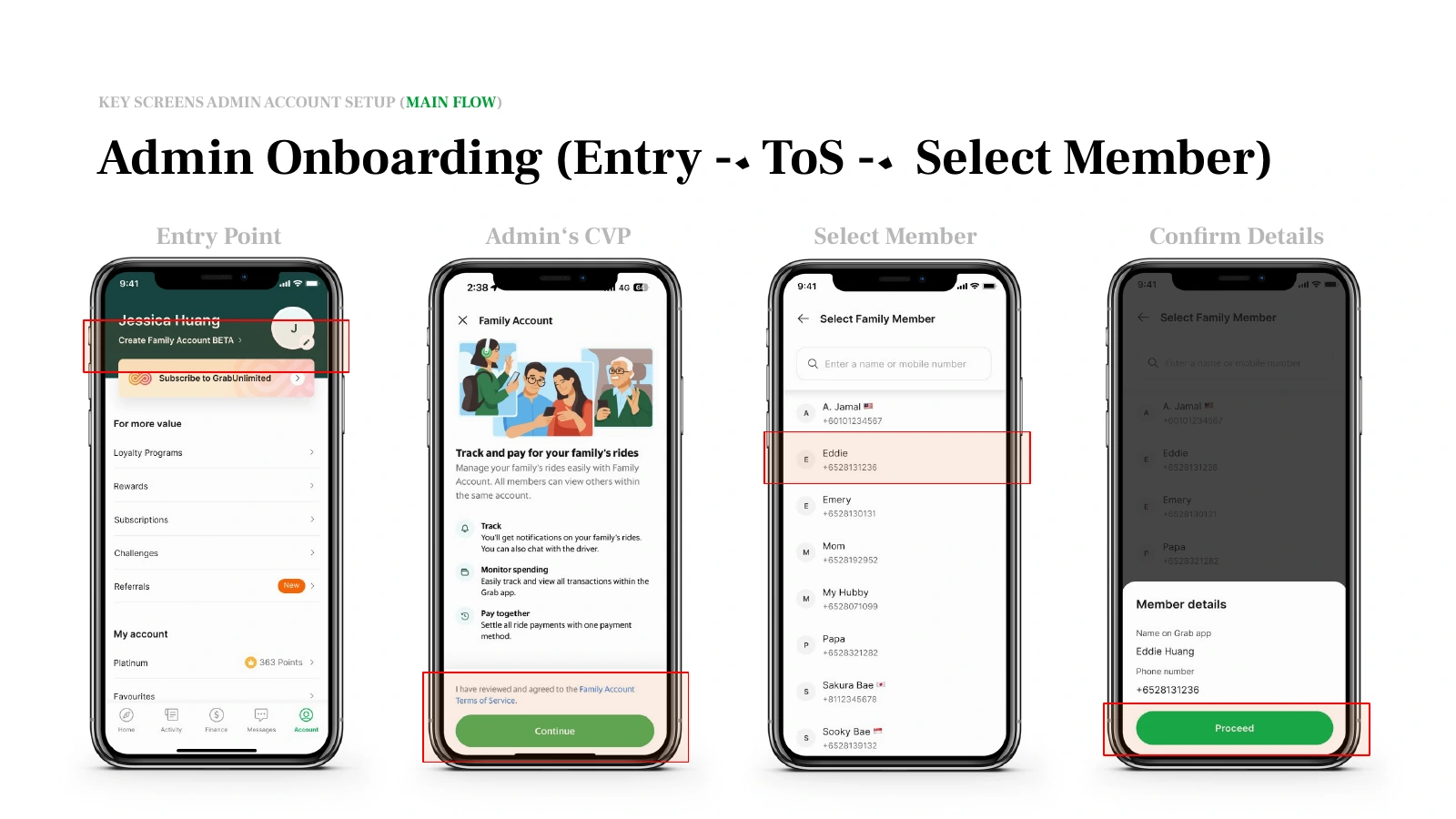
The first family connection ↗
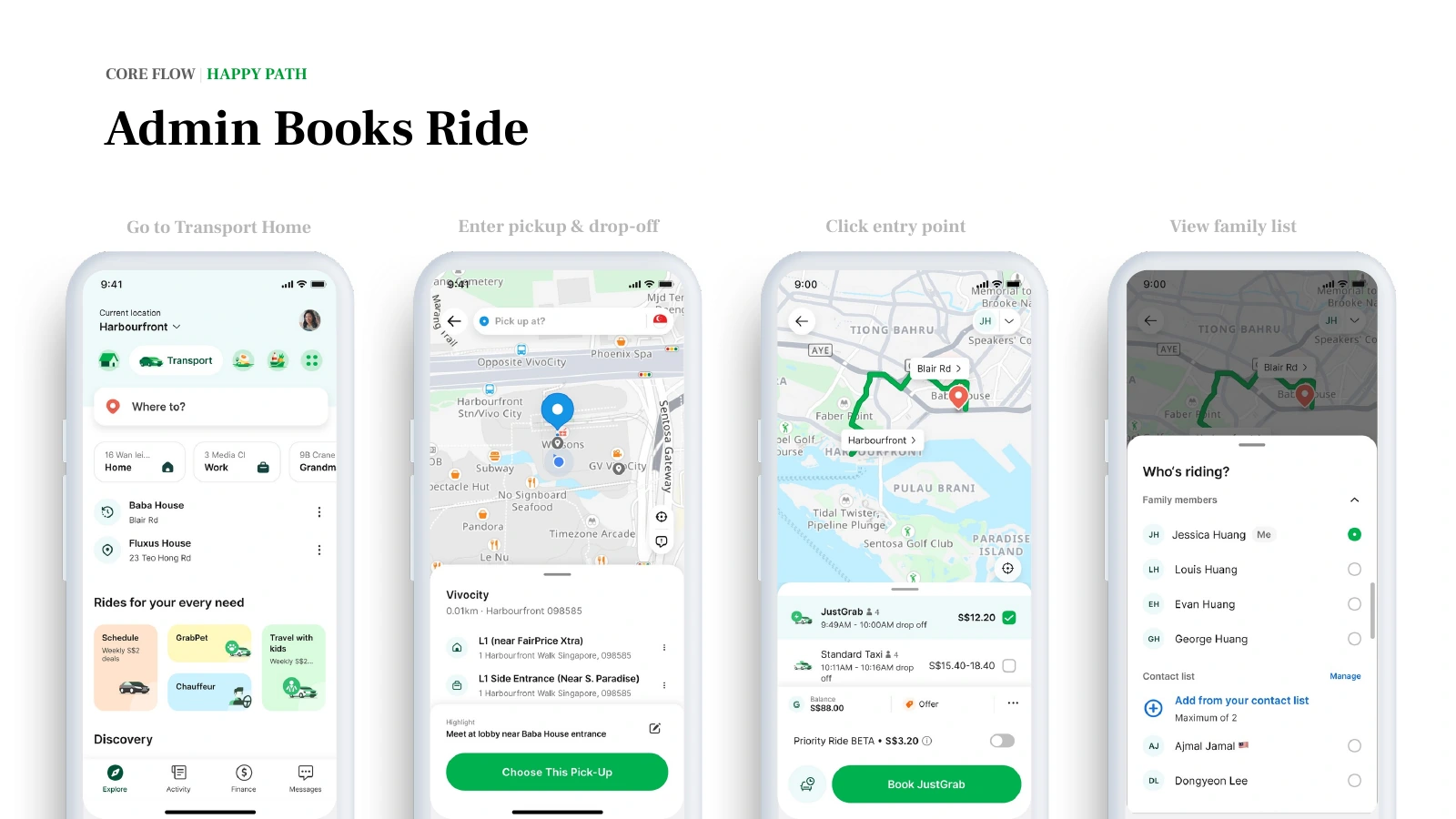
Booking for someone you love ↗
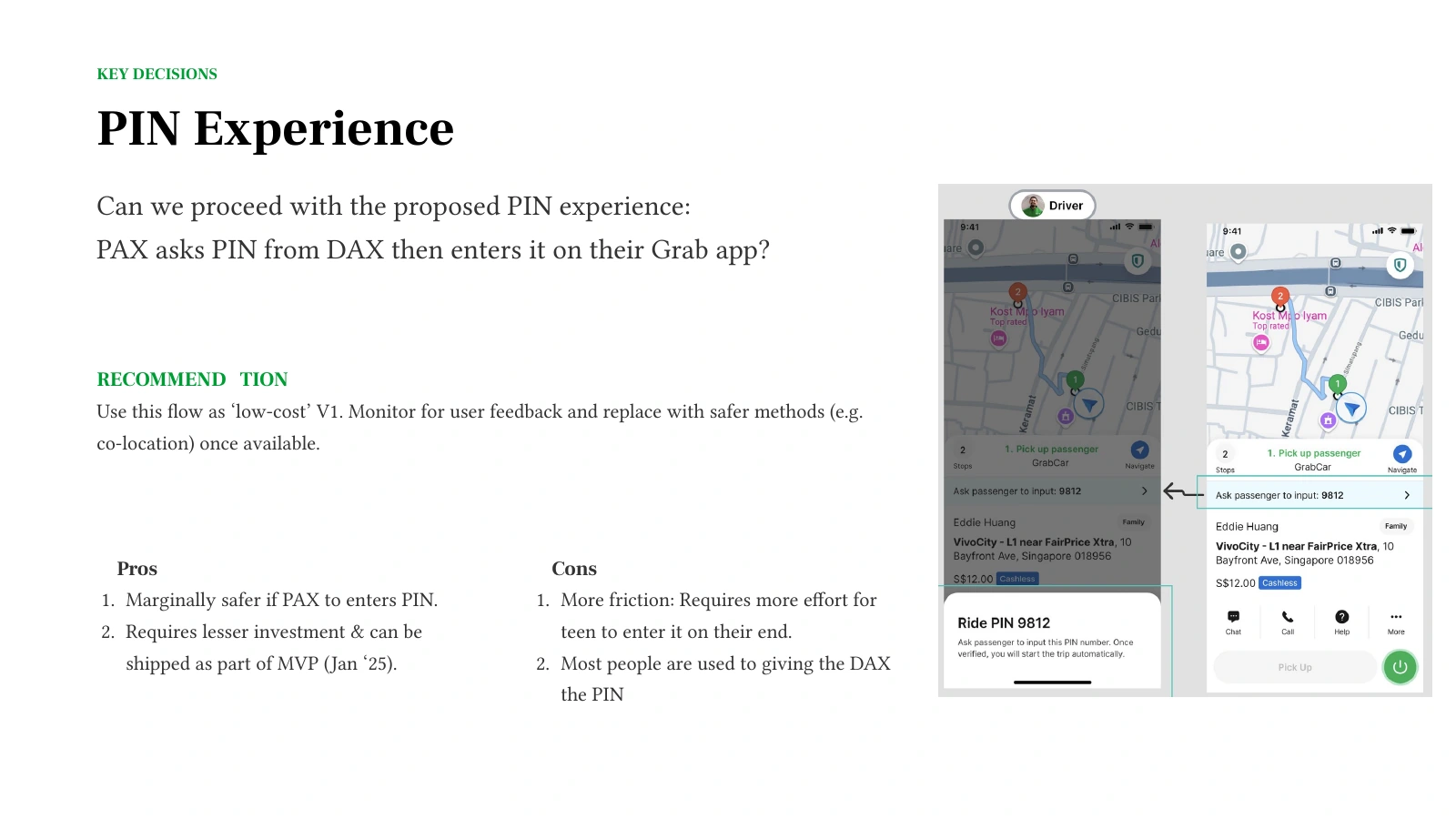
Making independence tangible ↗
21 May 2025
“We don't want engineering to throw away the MVP work.”
Excerpt · Lightly edited for this cardThe invitation decision ↗
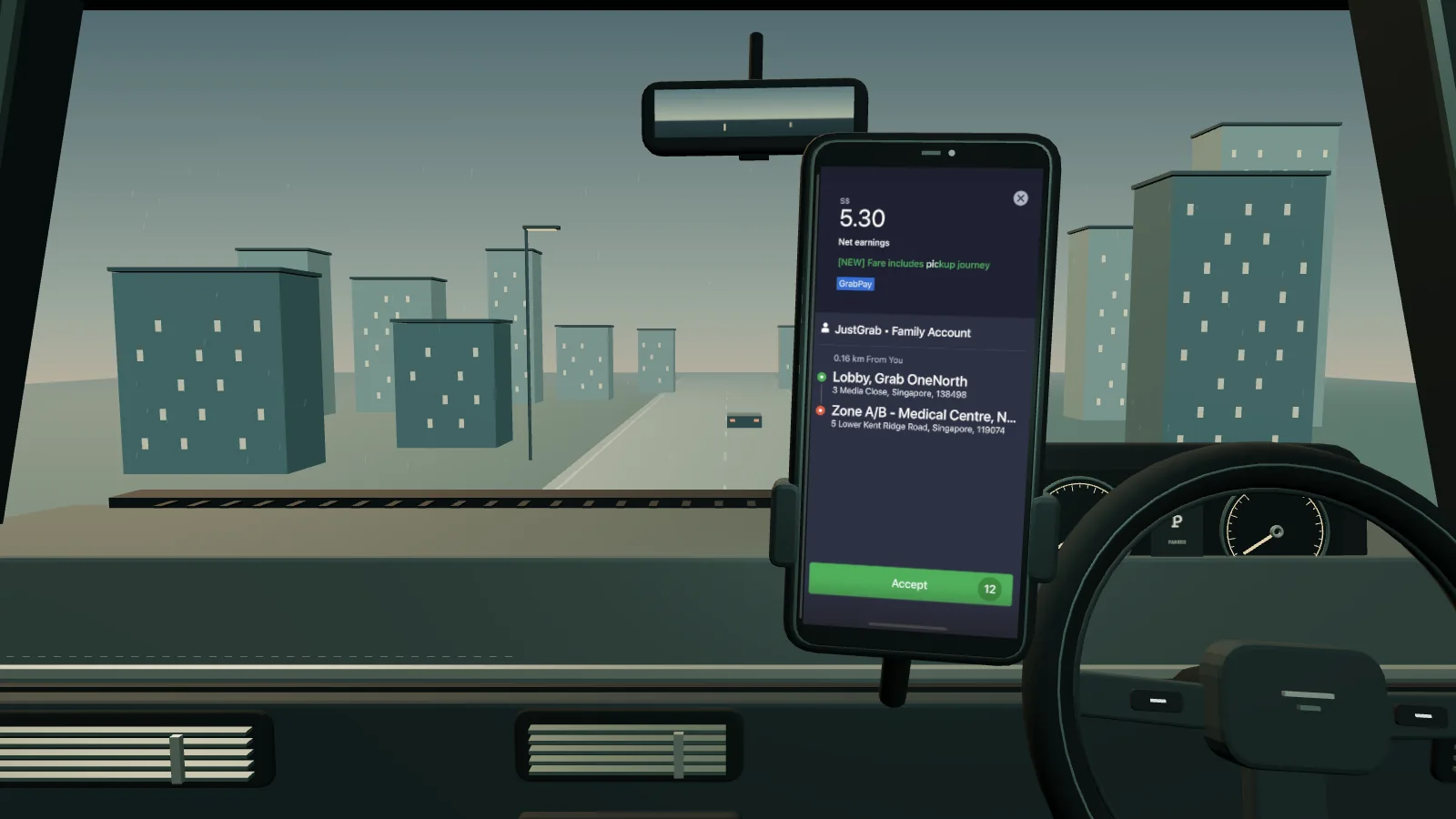
The view from the driver's seat ↗
Download the original Astra cockpit / GLB ↓New 3D presentation object · Includes historical sample UI
Out of Figma / Into the world
A familiar face
behind the feature.
In November 2024, Loh Kean Yew visited Grab. I walked him through Family Account: following a loved one's ride and booking for someone else.
It is a small record of the work leaving the design file and becoming something people can use.
Watch the original Grab Singapore film ↗Read the scene notes
The excerpt opens with Ajmal, identified on screen as Lead Product Designer. The conversation moves to keeping family connected during a ride. At approximately 22 seconds, the film shows the Family Account interface: selecting a family member, monitoring a ride and booking.
Editorial scene summary; the video retains its original English captions.
30-second excerpt · Original captions retained
The source trail
A story with its
working still attached.
- [1]Grab — Family Account ↗
Launch story dated December 2023 and later updated. Feature descriptions may include later releases.
- [2]Grab for Family ↗
Current, undated Malaysia product page; supports the interaction. The November 2024 launch film below supports the historical timing.
- [3]Grab — Teens and GrabX ↗
April 2025 announcement. Rollout, eligibility and available features vary by market.
- [4]Loh Kean Yew × Grab Singapore — Ajmal demonstrates Family Account ↗
26 November 2024. The original film credits Ajmal as Lead Product Designer and shows the booking-for-family experience.
- [5]Ajmal Afif — Family Account MVP
Day One entry, 21 May 2025. First-person evidence for the invitation tradeoff and team attribution.
- [6]Original design and research archive, 2023–2025
Family Account NPI, slide 24; Phase 2 PDA, slides 14–18, 27 and 32; Family Account Teens working deck, slide 50; January 2025 Research Report, slides 1–4 and 7–10. Detailed paths and evidence mapping are included in the companion research catalogue.
Original review slides have been re-rendered with font substitutions; source content is preserved.
The January 2025 research report credits Melvina for research, Kate and Ajmal for design, and Razil for content. The MVP invitation work also involved Razil, design leadership and CX; the invite-link idea came from Alex Hungate.
Astra's 3D environment and interactive companions were created with AI assistance for this retrospective. Original Grab artifacts remain credited to the product work. Written from recovered sources; no invented business results or participant testimonials.